
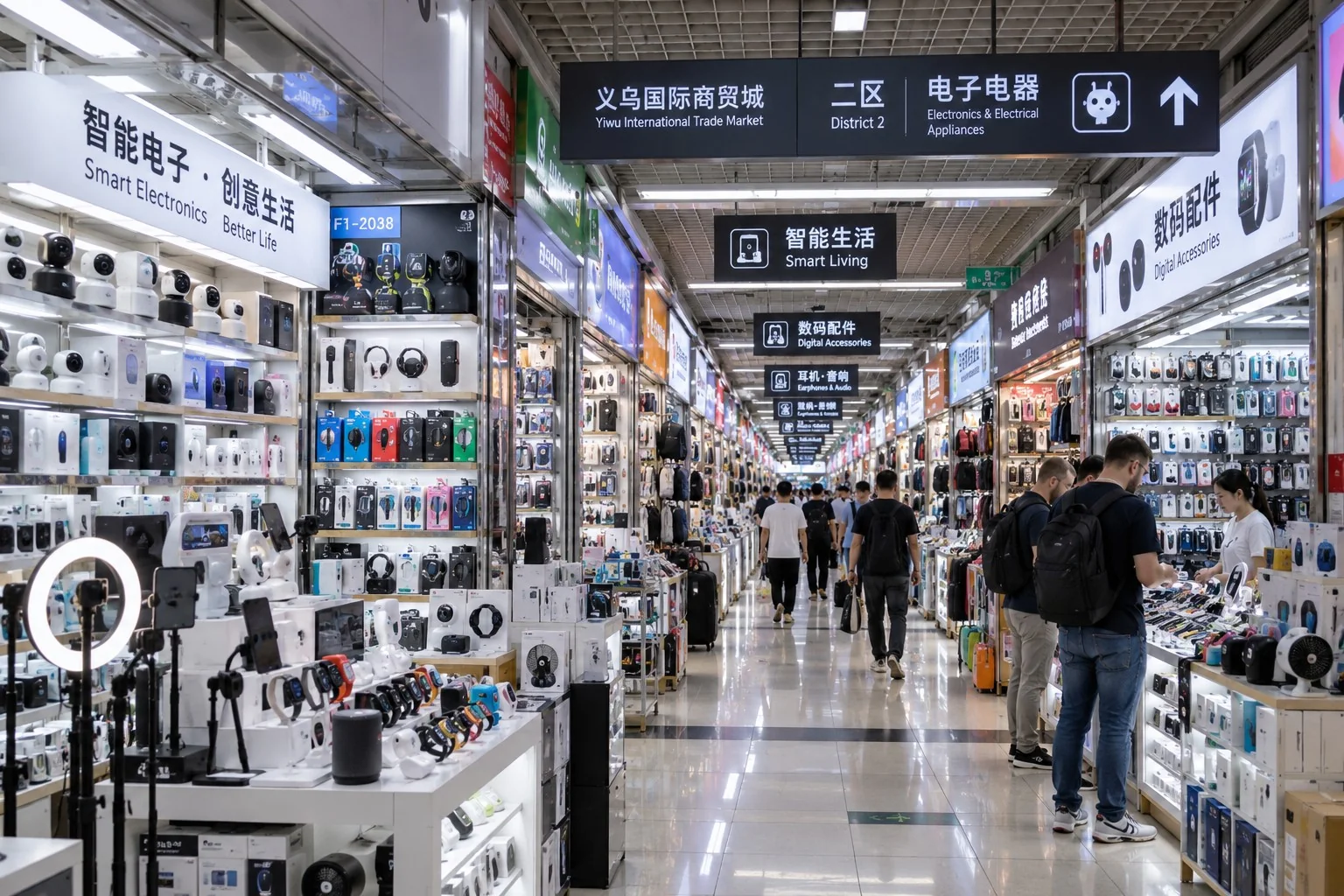
Most first trips to Yiwu end the same way. You walk a long way, collect a thick stack of booth cards, and come home with two usable quotes. The market is not difficult to buy from. It is difficult to navigate, because Yiwu International Trade City is not a market in the sense that most buyers expect.
It is five interconnected districts on the same street in Zhejiang, stocking more than two million product lines between them, organised by product category rather than by supplier. Once you understand the category map, a two-day trip is enough. Without it, the same trip produces a lot of walking and very little buying.
Why Yiwu Is a Different Kind of Sourcing Trip
Buyers who are used to Shenzhen arrive expecting another component cluster and find something else entirely.
- · Finished goods, not components: Yiwu trades in the small commodities that fill retail shelves, from toys and stationery to hosiery, hardware and home textiles
- · Ready stock rather than production slots: the stall in front of you usually holds the goods, which is why the buying cycle is measured in days rather than months
- · Booth-level wholesale: minimums are set per booth and are typically a carton or a few dozen, not a container
- · A trading floor, not a factory floor: many booths are the sales arm of a factory elsewhere in Zhejiang, and some are pure trading companies, so the entity you buy from is not always the entity that makes the goods
- · Domestic and export demand side by side: the market reports a strong export orientation, but the same booth also serves domestic wholesale, and the export version of a product is not always the one on display
The sister market to this one is in Guangdong rather than Zhejiang. Our Shenzhen and Huaqiangbei sourcing guide covers the electronics cluster; Yiwu covers everything else.
The Five Districts, and What Each One Sells
Each district is a large building with five floors, and each floor specialises. This is the part worth printing out before you travel.
District I: Toys, Headwear and Crafts
Opened in October 2002, this is the district most first-time buyers start in.
- · Ground floor: toys · plush, inflatable, electric and general toys
- · Second floor: headwear and fashion jewellery
- · Third floor: crafts, porcelain and crystal, photo frames, jewellery components
- · Fourth floor: factory direct sales, where the seller is the producer
- · Reported traffic: more than 80,000 visits a day, including over 3,000 overseas buyers, with the district reporting an export orientation above 70 percent
District II: Hardware, Luggage and Small Appliances
Opened in October 2004 and one of the two largest districts by booth count.
- · Ground floor: bags and luggage, umbrellas, rainwear and outdoor leisure goods, gift packaging
- · Second floor: hardware tools, electrical supplies, locks, vehicle and bicycle parts
- · Third floor: kitchen and bathroom hardware, small home appliances, telecom equipment, electronic instruments, watches and clocks
- · Fourth floor: factory direct sales, the level where you are talking to the producer rather than to a trading desk
- · Fifth floor: a foreign trade service centre, which is where documentation and consolidation questions get answered
District III: Stationery, Eyewear and Garment Accessories
Opened in September 2005, smaller and more specialised than the first two.
- · Ground floor: pens, paper products, eyewear
- · Second floor: office and study supplies, sports equipment
- · Third floor: cosmetics, zips, buttons and garment accessories
- · Fourth floor: factory direct sales
- · Fifth floor: the painting and art supplies trade
District IV: Hosiery, Underwear and Textiles
The largest district by floor area and by booth count, with more than 17,000 booths.
- · Ground floor: socks and leggings
- · Second floor: general merchandise, gloves, hats, knitwear
- · Third floor: footwear, laces and trims, ties, yarn, towels
- · Fourth floor: underwear, belts, scarves
- · Fifth floor: factory direct sales and tourist shopping
District V: Imported Goods, Home Textiles and Pet Supplies
Opened in 2011, the newest of the five original districts.
- · Ground floor: the imported commodities centre, with goods from more than 100 countries and regions
- · Bedding and home textiles, knitted raw materials, auto accessories, pet supplies, hotel supplies
- · Fifth floor: a national e-commerce demonstration base, which matters if the goods are destined for an online listing
- · A sixth complex is being developed east of District V, reported at more than 1.25 million square metres of floor area, and some categories are expected to migrate there as it opens
What the Market Costs, and How to Read a Quote
Yiwu pricing follows its own logic, and treating it like an Alibaba quote leads to wrong conclusions.
- · Quoted per piece, broken by carton: the stallholder will usually give a unit price and a carton price, and the carton price is the one that matters
- · Small quantity breaks: most booths drop the price at a few dozen or a few hundred pieces, far below the volume a factory would require
- · The first number is a starting number: the quoted price assumes you are a walk-in buyer, and it moves at the second or third visit
- · Sample cost is real cost: paying retail price for samples is normal at this stage, and it is cheaper than committing to a carton of a product you have not held
- · Mixed orders are the complication: buying ten products from ten booths is easy, and getting ten cartons out of China as one shipment is the part that needs planning
- · Market scale, for context: the trade city reports five districts, roughly 75,000 operating entities and more than 2.1 million product lines, with goods reaching more than 230 countries and regions · published figures differ by scope and date, so treat them as indicative rather than exact
The 1039 Route: Why Small Wholesale Orders Export Cleanly from Yiwu
The reason Yiwu can serve buyers who order a few cartons rather than a container is a customs regime designed for exactly that pattern. It is called market procurement trade, customs supervision code 1039, and its current form comes from the General Administration of Customs announcement number 221 of 2019.
- · Built for many small suppliers: it was created for goods bought inside an approved market cluster, in small quantities, across many product types, then consolidated into one export shipment
- · VAT exemption without refund (免征不退): goods exported this way are declared exempt from VAT and no export refund is claimed · this solves the missing-invoice problem that normally blocks small wholesale orders
- · Per-declaration value ceiling: a single customs declaration under 1039 is capped at USD 150,000, which is the practical limit on how much can be shipped in one go
- · Simplified declaration: where one declaration covers ten or more product types, only the top five by value need to be listed, which is what makes a mixed order of thirty small items workable
- · What it is not: prohibited and restricted goods are excluded, goods that carry an export refund are excluded, and product compliance rules still apply in full
- · Where it is administered: Yiwu runs a dedicated trade service platform for declaration and tracing, and the market's official platform at Chinagoods publishes supplier and product information
For a buyer assembling an order from a dozen booths, this matters more than any price negotiation. Without it, the order is legally awkward; with it, the order is ordinary.
How to Work the Market in Two Days
- · Plan by category, not by geography: decide before you arrive which two districts actually matter, because the walk between them is long and the floors are deep
- · Start on the upper floors: factory direct floors on level four are usually less crowded and staffed by people who can talk about production rather than only price
- · Collect booth cards and write on them: the card carries the booth number, the phone number and a messaging account, so note the product, the carton price and the date on the back
- · Photograph the sample next to the card: a photograph of the goods alone is useless three days later
- · Ask for the price at your real quantity, in writing, before you leave the booth
- · Buy samples on the spot and pay for them, rather than asking for a free sample by post
- · Message every booth on the evening of the visit, while the product is still fresh in their memory
- · Do not commit to shipping on day one: consolidate the quotes first, then decide what actually goes in the carton
Buying Direct Versus Buying Through an Agent
Both work, and the split is worth getting right.
- · Language: booth-level English is common in the districts that see the most overseas buyers, and less common on the factory-direct floors
- · Volume: a single-carton order from one booth is normal; a mixed order across fifteen booths is not something a stallholder will manage for you
- · Receiving point: consolidating needs somewhere to send the cartons and somebody to check what arrives
- · Inspection: the goods should be counted and checked before they are packed, not after they reach your warehouse, which is what our guide to pre-shipment inspection covers
- · Export paperwork: the 1039 declaration, the classification of a mixed shipment and the freight booking all sit outside the booth's scope, and our sourcing and purchasing service exists for that layer
- · Practical split: buy the goods yourself if you enjoy the market, and hand over consolidation, inspection and export to somebody who does it weekly
Practical Notes Before You Travel
- · Location: Yiwu International Trade City sits on Chouzhou Road, Futian Street, Yiwu, Jinhua, Zhejiang
- · Market customer service runs from 08:30 to 17:00, and the districts keep similar trading hours
- · Time the visit around the trade calendar: the market is busiest when international buyers are in the region for the Canton Fair, and our Canton Fair Autumn 2026 guide sets out those dates
- · Bring a measuring tape, a scale and a power bank: they settle more arguments at a booth than a business card does
- · Collect a sample of packaging, not just the product, because the export carton is often where a cheap product becomes an expensive one
- · Budget for shipping early: freight and clearance usually decide whether a thin-margin product works at all
- · If you cannot travel, the market's own platform lists suppliers and a local team can view, sample and quote on your behalf
FAQ
Can I really buy small quantities in Yiwu?
Yes. The market is built around wholesale in cartons rather than containers, and most booths are comfortable with an order in the low hundreds of pieces. What is not small is the logistics, which is why consolidation matters as much as the purchase.
How is Yiwu different from the Canton Fair?
The Canton Fair is a twice-yearly exhibition with scheduled phases and a fixed calendar. Yiwu is a permanent market that trades all year, organised by product category, where you can buy stock immediately instead of sampling and waiting for production.
Do I need to speak Chinese?
Not for buying, generally. English is workable in the busiest districts. For the export side, including the 1039 declaration and the classification of a mixed shipment, working with a Chinese-speaking counterpart removes most of the risk.
Is Yiwu cheaper than sourcing on domestic platforms?
Rarely on the item price alone, and frequently on the total cost. The advantage is seeing the goods, comparing booths in person and consolidating a mixed order into one shipment. Buyers who need a single standardised product at high volume are usually better served by a factory, and buyers sourcing a range are usually better served by the market.
Build the Order Before You Fly
Yiwu rewards preparation more than most sourcing destinations, because the market is a map rather than a catalogue. Decide which districts matter, budget the consolidation before you buy, and the trip turns into an order instead of a walk.
Easy Buy China works with overseas retailers and e-commerce sellers across China's main export hubs, including Yiwu, and handles the layer the market itself does not: receiving cartons from multiple booths, checking them before packing, arranging the export declaration and combining them with orders from other cities. Low MOQ is standard, the consultation fee is $0, and a first order does not need to fill a container. Small-volume buyers can start with our guide to sourcing for small retailers.
Contact us with the categories you are considering and we will tell you which districts to visit, and in what order.