
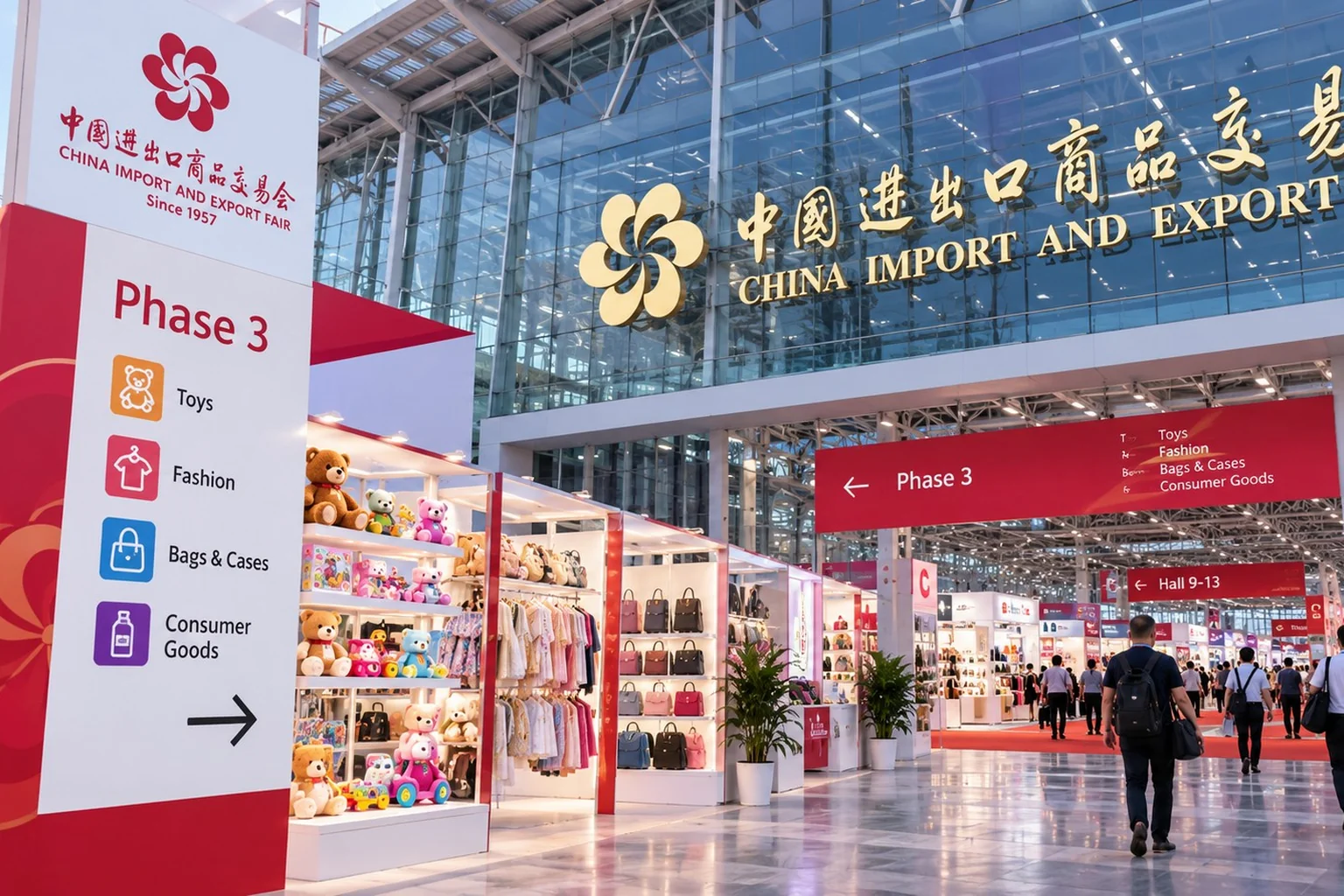
Phase 3 of the 140th Canton Fair runs from 31 October to 4 November 2026, and it is the widest phase for consumer goods. Toys, apparel, fashion accessories, bags and personal care: these are the categories that fill a retail catalogue rather than a single product line.
Because this is a preview, it does not describe booths that have not opened yet. It sets out what to prepare, and Phase 3 rewards preparation more than any other phase, because the categories are documentation-heavy and the range is enormous.
What Phase 3 Covers
According to the official exhibition information, Phase 3 concentrates on consumer-facing categories. For a wholesale buyer the relevant families are these.
- · Toys: plastic, plush, educational and electronic toys, plus games and puzzles
- · Children and baby products: clothing, feeding, nursery items and maternity goods
- · Apparel: men's, women's and children's wear, underwear and sportswear
- · Fashion accessories and bags: jewellery, scarves, belts, handbags, luggage and cases
- · Personal care and household consumables: grooming, beauty accessories and daily-use items
Five families, five different compliance regimes, and very little overlap in the way they are bought. That is the structural problem of Phase 3, and it is why a category decision made in advance matters more here than in Phase 1 or Phase 2.
Build a Shortlist of Three Categories, Not Thirty
The fair is too large to browse. A team that arrives without a category decision tends to spend the first day orienting, the second collecting catalogues, and the third discovering that the catalogues do not answer the question it came with.
- · Priority categories: no more than three, chosen before travel and written down
- · Target customer: the actual buyer in your market, not a general audience description
- · Expected volume: a realistic first order and a realistic reorder, in units and cartons
- · Destination market: because the compliance route for a toy sold in the EU is not the route for the US
- · Price band: the retail price you need to hit, worked back to a target landed cost
Then use the official exhibitor and product discovery channels to build a shortlist before you travel, so the halls confirm a hypothesis rather than generate one. Ten to fifteen exhibitors per category is a working shortlist. A hundred is a suitcase of paper.
Toys Are a Documentation Category
Toys are where a retail buyer is most exposed, because the requirements are specific, they are checked at the border, and they differ by market.
Age grading is not a marketing label. It determines which safety tests apply, which warnings must appear and how the product must be constructed. A test report that covers a similar product is not a report that covers this product, and the model number on the report has to match the model number on the carton.
For anything with a battery, a radio module or a mains adapter, the toy rules are only part of the file. Transport rules for lithium cells, radio equipment requirements and electrical safety each add their own document, and each is checked by a different party.
Apparel, Bags and Private Label
Apparel and bags look simpler and are not. The variables that decide whether a reorder works are measurable, but they are rarely volunteered, and each one has to be asked for in the quotation.
- · Fibre content and shrinkage: stated as a percentage with a test method, not as a claim
- · Colour fastness: to washing, rubbing and light, at the grade your market requires
- · Stitch density and seam strength: measured on the production sample, not on the showroom piece
- · Hardware and trims: plating, nickel release and pull strength on zips, buckles and rings
- · Size chart tolerance: the measurement points and the allowed deviation, in centimetres
For private label, the questions move earlier. Minimum quantity per colour and per size, trademark ownership, logo placement, labelling and the sample approval process all need an answer before a deposit, because each of them can move the production calendar by weeks.
Ask for the size chart in numbers rather than in letters, the colour standard by reference rather than by name, and the packaging artwork in a file you can approve in writing.
From Booth to Sample to Order
The fair produces contacts. The order is produced by what happens in the four to six weeks afterwards, and the buyers who convert are the ones who sent a structured request rather than a friendly message.
What to send: the specification, the quantity, the destination, the target date and the compliance documents you will require at shipment. What to ask for: a quotation against that specification, a production lead time with a start date, and a sample that matches the production version rather than the showroom version.
That last point is the one most often skipped. A showroom sample and a production sample are different objects, and the difference between them is where retail returns come from.
FAQ
When does Canton Fair 2026 Phase 3 take place?
The official dates are 31 October to 4 November 2026, at the Canton Fair Complex in Pazhou, Guangzhou. It is the third and final phase of the 140th session.
Which products are shown in Phase 3?
Consumer-facing categories, including toys, children and baby products, apparel, fashion accessories, bags and luggage, personal care and household consumables. The official exhibition information is the reference for the exact category list.
Do I need to attend to buy from Phase 3 exhibitors?
No. The official exhibitor and product discovery channels are enough to build a shortlist and request quotations. Attending adds the ability to handle samples and judge finish, but it is not a precondition for placing an order.
Work Phase 3 With a Plan
Phase 3 opens on 31 October 2026. The buyers who get value from it are not the ones who cover the most ground, but the ones who arrive with three categories, a shortlist and a specification they can send the same afternoon.
Easy Buy China works with overseas retailers and distributors on consumer goods from China's main export hubs, including pre-shipment inspection for toys, apparel and bags. If your range also touches home products, the Phase 2 guide covers the week before this one, and the Canton Fair autumn 2026 guide carries the full phase map and registration steps.
For compliance on toys and on children's products with electronics inside, our guide to CE, FCC and RoHS requirements explains what the documents actually have to prove. Contact us with your category list and we will help you build the shortlist before the halls open.