
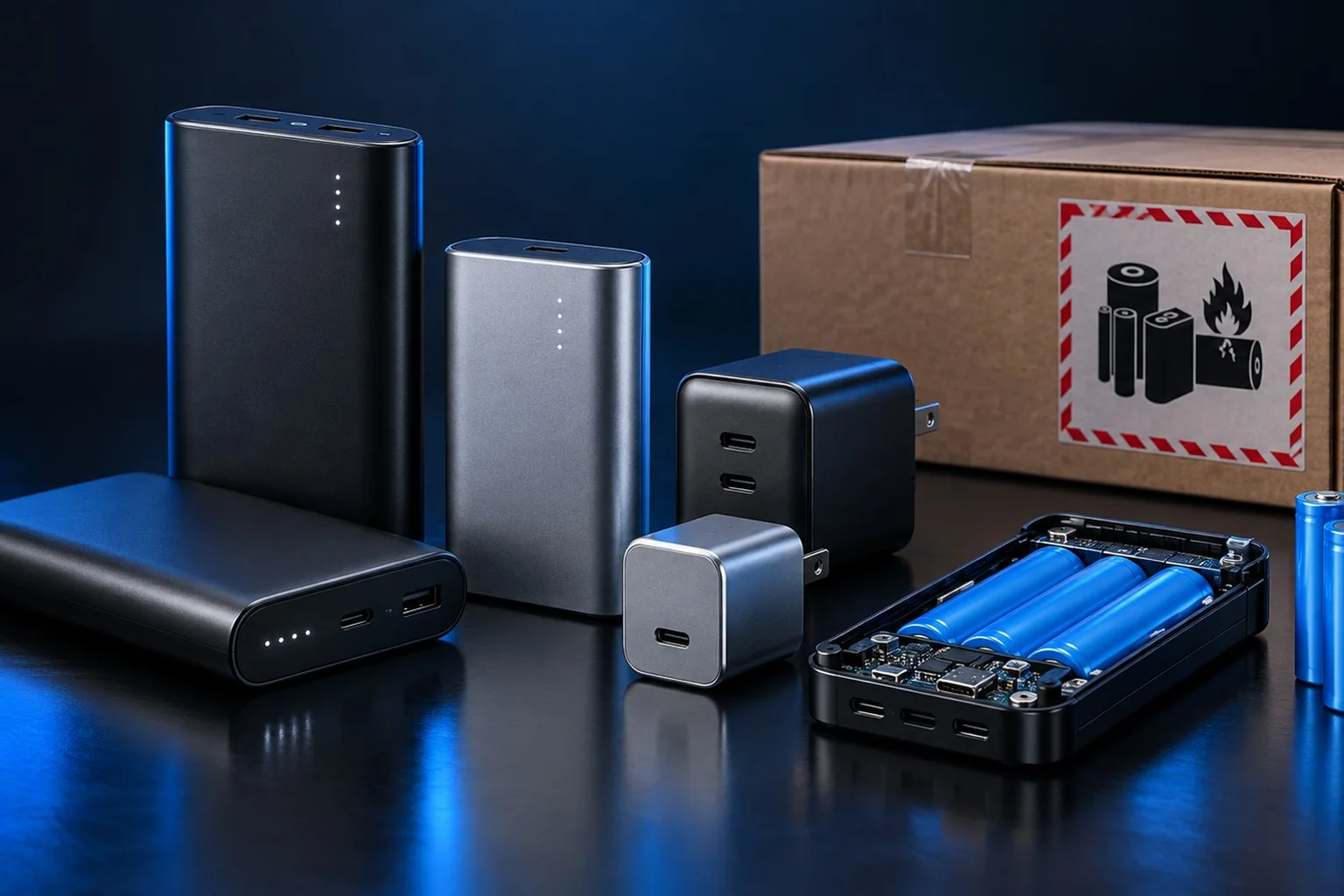
In most electronics categories the binding constraint is certification. In power banks and charging products it is transport, and transport is decided earlier than certification because it determines whether the goods can move at all.
The rule that matters most changed on 1 January 2026. Lithium ion cells and batteries shipped by air must now be offered at a state of charge no higher than 30 percent of rated capacity, and this became mandatory rather than advisory. A factory that builds power banks to leave the line fully charged, which is the long standing practice, is now building a product that cannot fly.
That is not a paperwork problem. It changes what you specify, how the units are prepared, what they cost, and in some cases which transport mode is available to you. This guide works through it, and through the adjacent rules that a buyer in this category needs to hold at the same time.
For the general certification file that applies to any electronic import, the marks, the issuers and how to verify them, our compliance guide covers that ground.
The Air Transport Rule That Changed in January 2026
The applicable framework is the IATA Dangerous Goods Regulations. The 67th edition took effect on 1 January 2026, and its most consequential change for this category concerns the charge level at which batteries travel.
- · Lithium ion cells and batteries offered for air transport at a state of charge must now meet a mandatory limit rather than a recommended one
- · The limit is a state of charge not exceeding 30 percent of rated design capacity
- · The requirement is written against lithium ion cells and batteries shipped by themselves, which is the UN3480 classification and packing instruction 965 territory
- · Shipping above the limit is not simply prohibited. It requires approval from the state of origin and from the state of the operator, which is a route most commercial shipments will not take
- · The practical reading for a buyer: the default air shipment of a power bank is a consignment prepared at 30 percent charge or less
- · The rule arrived with the 67th edition, so quotations and packing specifications written before 2026 may not reflect it
What the Limit Applies To
- · Cells and batteries shipped on their own, as loose stock or as a product with no other function, fall under the shipping-by-itself classification
- · Batteries contained in equipment, and batteries packed with equipment, are handled under different classifications with their own packing requirements
- · Because a power bank is a battery that is the product, it is generally treated as a battery shipped by itself rather than as a battery inside something else
- · Where a product contains a battery but is not itself a battery, the classification turns on how the unit is packed and declared
- · The classification determines the packing instruction, the labelling and the documentation, so it is worth confirming in writing with the carrier rather than assuming
- · A supplier who cannot state which classification a shipment falls under is a supplier who has not shipped it recently
Why This Reaches Your Purchase Order
This is the part that surprises buyers, because it is a production instruction rather than a shipping instruction.
- · A unit must leave the factory at or below the charge limit if it is to be shipped by air, which means the discharge step belongs in the production plan
- · That step costs labour, and it costs a charging cycle on every unit, which is a real line item rather than a rounding error
- · It also means the units arrive partially charged, which changes what the buyer must tell their own customer about first use
- · The charge preparation has to be verified rather than assumed, since a unit that leaves at 60 percent has to be reworked before it can fly
- · Where a supplier claims to prepare units at the limit but cannot show a test record per batch, the claim is unverified
- · The specification point to write into the order: the maximum state of charge at which units are packed for air, and the evidence provided per shipment
The Two Classifications and Why They Differ
The dangerous goods framework separates batteries by how they travel, and the separation determines everything downstream.
- · A battery shipped by itself carries one classification, and it is the one subject to the charge limit and to the strictest packing requirements
- · A battery contained in equipment carries a different classification, with packing requirements that reflect the battery being inside a finished device
- · A battery packed with equipment is a third case, where the battery travels alongside a device rather than inside it
- · The three cases have different packing instructions, different marking and different documentation
- · For a power bank the classification is usually the first case, because the battery is the product
- · For a charger that contains a small cell, or for a device with an integrated battery, the position depends on how the unit is presented and declared
- · Misclassifying a shipment is not a paperwork defect. It is a shipment that can be refused or, worse, loaded onto an aircraft it should not be on
- · The control is to have the classification stated in writing by the supplier and confirmed by the carrier before the goods are packed
What This Changes in Packing and Cost
The charge limit interacts with packing, and the interaction is where the cost appears.
- · Packing must be appropriate to the classification, and the packing instruction that applies follows from the classification rather than from the product type
- · Marking and labelling requirements attach to the consignment, so the cartons must be prepared for the mode rather than for the warehouse
- · Documentation has to be prepared for each shipment rather than once for the product, which adds a recurring administrative cost
- · Air transport is the mode most affected, which means that where a buyer has been shipping by air the change is material rather than theoretical
- · Sea transport is not subject to the same charge limit, which is why the ocean route becomes more attractive for this category once volume justifies it
- · The trade off is the one that always applies between air and sea, now with an additional production step on the air side
The Options, and What Each One Costs
- · Prepare units at or below the limit and continue shipping by air: no change of mode, but a discharge step on every unit and a per shipment verification burden
- · Ship by sea instead: the charge limit does not apply in the same way, but transit time and the need for volume to justify a container both apply
- · Ship partially by air for the urgent portion and by sea for the balance: splits the cost but requires the production to be scheduled around two modes
- · Source units already specified at a low state of charge as standard: this is a product decision rather than a logistics one, and it is the cleanest long term answer
- · Where a buyer has been relying on air for a fast moving line, the honest comparison now includes the discharge step rather than only the freight rate
What the EU Battery Rules Do and Do Not Cover
The European Union regulates batteries under Regulation (EU) 2023/1542, which entered into force on 17 August 2023, applies from 18 February 2024, and rolls out phased requirements through 2031.
- · The regulation is framework legislation, so the obligations differ by battery category rather than applying uniformly to everything called a battery
- · The categories that matter commercially are portable batteries, batteries for light means of transport, industrial batteries and electric vehicle batteries
- · The widely discussed battery passport becomes mandatory from 18 February 2027, and its scope is the categories above certain thresholds rather than every battery
- · A power bank is a portable battery, which means the passport requirement is not the one that applies to it
- · A battery placed on the market before the passport requirement applies does not need a passport retroactively
- · Because the requirements are phased, the practical approach is to establish which category the product falls into before quoting compliance dates, since the answer differs by category
Why the Passport Does Not Apply to a Power Bank
This is worth stating clearly, because the passport is the requirement most often quoted at buyers in this category and it is usually the wrong one.
- · The passport obligation is written for batteries for light means of transport, industrial batteries above a capacity threshold, and electric vehicle batteries
- · Those are the large format categories, where traceability across a long service life carries the most weight
- · Portable batteries, which is what a power bank is, are covered by the regulation's other obligations rather than by the passport
- · The obligations that do apply to portable batteries concern matters such as labelling and end of life handling, and they are phased over time
- · The practical consequence: a supplier warning that a power bank needs a battery passport by February 2027 is describing the wrong requirement, which is a useful signal about how well they follow the rules
- · The verification point is the official Commission page for the regulation, where the phasing is set out, rather than a summary from a supplier or a trade article
What to Specify in a Power Bank Order
With the transport and regulatory picture established, the product specification is what determines whether the order is repeatable.
- · Cell capacity in watt hours rather than milliamp hours alone, since watt hours is the figure that governs transport thresholds and airline rules
- · Cell provenance and grade, because the difference between a first tier cell and an unbranded equivalent is not visible in the capacity figure
- · Charge and discharge protocols supported, stated by standard rather than by brand name
- · The maximum state of charge at which units are packed for air, with the per batch evidence the supplier will provide
- · Cycle life at a stated depth of discharge, since a cycle claim without the test conditions is not comparable
- · Overcharge, over discharge and thermal protection, together with whether the protection is a separate circuit or integrated
- · Ingress protection, because a portable product will be carried in a bag and the rating should match that reality
- · Marking and language requirements for the destination market, since these differ and are easier to set at the artwork stage than to correct later
Chargers, Cables and the Adapter Market
The rest of the category carries fewer hard constraints, which makes it a useful complement to a power bank line.
- · Chargers and cables are not subject to the battery transport rules in the same way, so they move on normal freight terms
- · The binding requirements for a charger are the usual electrical safety and electromagnetic compatibility approvals for the destination market, together with the mains plug format
- · Plug format is a market decision rather than a product decision, and getting it wrong makes a shipment unsellable in the destination without an adapter
- · Cable specification matters more than it appears, because the charging rate a device achieves is limited by the cable as well as by the charger
- · For a buyer building a range, chargers and cables are the parts that can be ordered and shipped without the battery constraints, which improves overall cash flow on a mixed order
What Gallium Nitride Changed
- · Gallium nitride switching allows a charger to be smaller and cooler at the same output, which is a genuine product difference rather than a marketing term
- · It also raises the price, so the decision is which price band to compete in rather than whether the technology is better
- · Because the benefit is size and heat rather than raw power, the specification to compare is the physical size at a stated output rather than the output alone
- · Certifications apply as with any charger, and a high density design makes thermal behaviour worth checking rather than assuming
FAQ
Can I ship a power bank by air
Yes, provided lithium ion cells and batteries shipped by themselves are offered at a state of charge not exceeding 30 percent of rated capacity, with packing, marking and documentation matching the applicable classification. Above that level requires approval from the state of origin and the state of the operator.
Does the 30 percent rule apply from January 2026
Yes. It arrived with the 67th edition of the IATA Dangerous Goods Regulations, effective 1 January 2026, and it is mandatory rather than recommended. Quotations and packing specifications written before that date may not reflect it.
Does a power bank need an EU battery passport
No. The passport obligation applies to batteries for light means of transport, industrial batteries above a capacity threshold and electric vehicle batteries. A power bank is a portable battery, which is subject to the regulation's other phased obligations rather than to the passport.
Does shipping by sea avoid the charge limit
The charge limit is written into the air transport rules, so the sea route is not subject to it in the same way. The trade off is transit time and the volume needed to justify a container, which is why many buyers split an order between the two modes.
How do I verify that a supplier prepared units at 30 percent
Ask for a per batch record of the state of charge at packing, and confirm in writing which classification the shipment falls under. A supplier who cannot state the classification has probably not shipped this kind of consignment recently.
Are chargers and cables subject to the same rules
No. They are not batteries, so the battery transport rules do not apply in the same way. They still need the electrical safety and electromagnetic compatibility approvals for the destination market, and the correct mains plug format.
The Order of Decisions
- · Establish the transport mode first, because it determines whether the charge limit and the packing requirements apply at all
- · Confirm the dangerous goods classification in writing with the supplier and then with the carrier, rather than assuming from the product type
- · Specify the maximum state of charge at packing and the per batch evidence, so the discharge step is a contractual item rather than a favour
- · Price the discharge step into the unit cost rather than treating it as free, since it consumes a cycle and labour on every unit
- · Check the EU requirements by battery category, because the passport applies to large format batteries rather than to portable ones
- · Set the mains plug format and marking by destination market at the artwork stage, where changes are cheap
- · Treat chargers and cables as the part of the range that ships on normal terms, and use them to smooth cash flow across a mixed order
Our power and charging range covers the product families this applies to, and our warehouse and delivery service page describes how we handle the preparation and consolidation steps. For the freight environment these shipments move into, our ocean freight rates update covers the current position.
If you want a specific product or supplier checked against the transport and destination requirements before you commit, contact our team with the product and the destination market.