
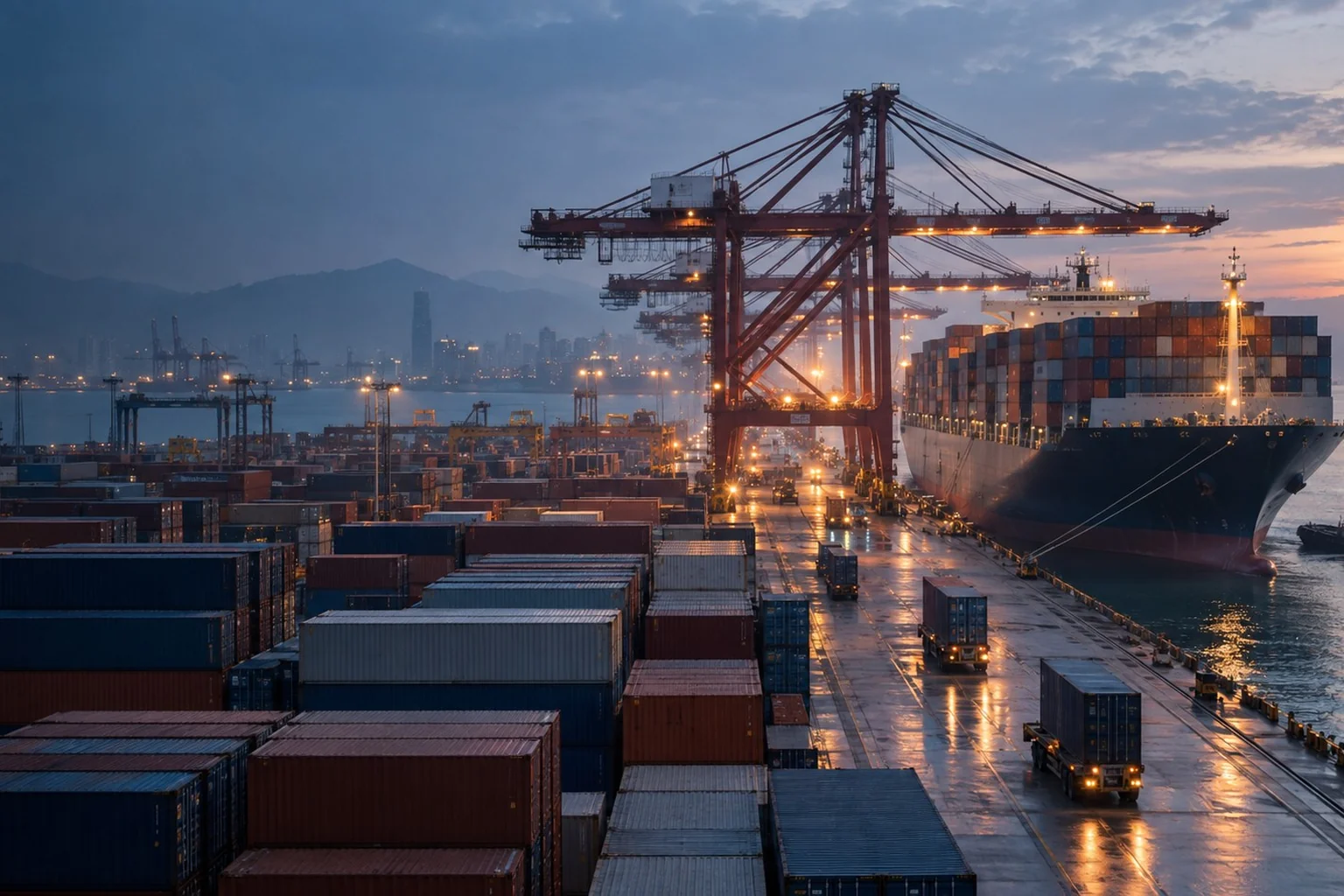
China to US ocean freight rates moved higher again in the third week of September 2026, and this time the constraint is capacity rather than demand alone.
Rates on the transpacific rose by roughly $500 to $600 per container week over week, extending a climb that has run through most of September. West Coast pricing sits near $7,000 to $8,000, and East Coast pricing is above $10,000 on several services. Carriers have already announced blank sailings around the October holiday, which means the vessels are being removed at the exact moment shippers are trying to move cargo before Chinese factories and freight operations close.
This is a snapshot of a market, not a planning calendar. If you need the dates of the shutdown windows themselves, our Q4 holiday sourcing calendar sets out the Mid-Autumn, National Day and Spring Festival periods in full. What follows is narrower and more time-sensitive: what rates and capacity are doing right now, how long the disruption is likely to last, and what to do in the fortnight that remains.
What the Rates Are Doing Right Now
The headline numbers for the week of 14 September 2026, in a weekly transpacific market report published on 16 September:
- · China to US West Coast: approximately $7,000 to $8,000 per container
- · China to US East Coast: above $10,000, reaching approximately $11,000 on some services
- · Week-over-week movement: an increase of roughly $500 to $600 per container, extending the trend from earlier in September
- · Best available spot pricing: as low as $6,400 to the West Coast and $8,500 to the East Coast, according to the same report's rate indicators
- · Direction of travel: upward, with carriers describing firm control over available capacity
- · What is not happening: no sign of the rate softening that usually follows a peak
The gap between the headline rate and the best available spot rate is worth noting. It is roughly $600 to $1,500 per container depending on coast, which is the spread a buyer can capture by working with a forwarder who is actively shopping the market rather than accepting the first quotation.
Why Rates Can Rise When Demand Is Not Booming
The counterintuitive part of the current market is that rates are climbing while underlying demand is described as contained. That combination is a capacity story, not a demand story.
- · Blank sailings: carriers are cancelling sailings and removing vessels, which keeps supply below the level that would otherwise exist
- · The holiday effect: those removals are concentrated around the October holiday, when Chinese factories and freight operations close
- · The result: supply is being cut precisely when the remaining pre-holiday cargo needs to move, so the squeeze is manufactured as much as it is earned
- · Why it works: with capacity withdrawn, a moderate level of demand is enough to fill what is left and support further rate increases
This is the pattern to understand if you are timing a shipment. On the transpacific, rates do not only respond to how much cargo wants to move. They respond to how much capacity the carriers choose to leave in the water, and that choice is currently restrictive.
Demand Is Strong, but It Is Not the Whole Story
It would be wrong to describe this as a purely artificial squeeze. Chinese export volumes are genuinely running high, and the official figures published on 8 September 2026 confirm it.
- · First eight months of 2026: goods trade totalled RMB 34.78 trillion, up 17.6 percent year on year, according to China's customs administration
- · Exports over the same period: RMB 20.17 trillion, up 14.6 percent
- · August alone: total goods trade of RMB 4.65 trillion, up 19.8 percent, with exports at RMB 2.73 trillion, up 18.6 percent
- · Mechanical and electrical products: exports up 21.9 percent over the first eight months, outpacing the overall figure
So the demand side is real, and it is concentrated in exactly the category most buyers on this site work with. What that means is the two forces are pointing the same way at the same time: strong volumes plus withdrawn capacity, in the weeks before a national holiday.
Reliability Is Now the Bigger Problem Than Price
The most consequential change in this market is not the rate level. It is that schedules have stopped being dependable.
- · The mechanism: a shipment can secure space and still see its scheduled departure pushed back by several days
- · The compounding effect: when a booking rollover combines with a delayed vessel departure, total delays can approach two weeks
- · The cause in part: earlier typhoon disruption knocked vessel rotations out of sequence, and a vessel arriving late at one port tends to stay behind schedule through subsequent calls
- · What carriers are doing: restricting capacity through blank sailings and vessel removals, which reduces the slack that would otherwise absorb a delay
- · What the market report recommends: increase booking lead time from roughly one week to two to three weeks, even when the cargo is not yet ready
That last point is the actionable one, and it is counterintuitive. Conventionally you book when the goods are ready. In a market with unreliable schedules, you book earlier and accept that the container may wait, because the alternative is missing the pre-holiday window entirely.
The Fuel and Weather Factors Behind the Numbers
Two operational factors are adding support to rates and are worth tracking separately from the capacity story.
- · Fuel: higher fuel costs are feeding into carrier pricing, giving carriers an additional argument for increases beyond the capacity story
- · Weather: typhoon disruption earlier in the season is still working through vessel rotations, so schedule instability has a cause that will not clear the moment the holidays end
- · The distinction matters: capacity discipline is a commercial decision that can reverse quickly, while a disrupted rotation has to be physically recovered
- · Practical consequence: even a sudden improvement in carrier behaviour would not immediately restore schedule reliability
Air Freight Is Firming, Not Surging
Air freight is the natural alternative when ocean space tightens, and the current signal is mixed.
- · West Coast gateways: Los Angeles around $5.20 to $6.80 per kilogram for larger standard-density shipments, San Francisco around $5.20 to $6.00 per kilogram
- · East Coast gateways: New York around $6.00 to $6.80 per kilogram for standard-density cartonised cargo, with some services above $7.00 per kilogram for pallets
- · Direction: mildly higher week over week, but described as firming rather than surging
- · Why it has not surged yet: the expected September pickup has not developed significantly, so capacity remains available and carriers have limited room to push through larger increases
- · The risk to watch: the window before Golden Week is narrowing, and concentrated demand in the final two weeks of September could tighten capacity quickly
Should I Switch to Air Freight
- · Yes, if the shipment is small, high value per kilogram, and genuinely needed on the shelf before the holiday
- · Probably not, if the only reason is to avoid a rate increase, because the ocean increase so far is smaller than the air premium on most density profiles
- · The comparison to run: the air rate in dollars per kilogram against the ocean rate per container divided by the units in that container
- · The overlooked cost: air freight does not solve a factory that has closed for the holiday, so the production window matters as much as the transport mode
What Happens After Golden Week
The market report's forward view is more specific than usual, and it is worth setting out because it determines whether waiting is a strategy.
- · The next two weeks: expected to be the final major ocean freight push before the holiday, keeping space tight and rates elevated through the remainder of September
- · Immediately after the holiday: conditions may remain difficult as carriers work through accumulated cargo and reduced sailing capacity
- · Late October: ocean demand is expected to cool as much of the inventory intended for the year-end selling season has already moved
- · November and December: the potential exists for rates to move lower, before another seasonal push develops ahead of Chinese New Year
- · The caveat stated in the report itself: operational reliability may matter more to importers than another few hundred dollars of rate movement
Will Rates Fall After Golden Week
Possibly, from late October, on the report's own reading of demand. But two qualifications apply. First, a rate decline does not restore the schedule reliability that has already been lost. Second, the pre-Chinese New Year push is not far behind, and the factory shutdown window around that holiday is the tighter constraint on a Q1 replenishment plan.
How to Book in the Two Weeks That Remain
The market report's central recommendation is a change to booking behaviour rather than a change of route or mode.
- · Extend the lead time: move from roughly one week to two to three weeks between booking and intended sailing
- · Book before the cargo is ready: space is the scarce item, not readiness, so secure it first and let the container wait
- · Expect rollovers: plan a buffer for the possibility that a confirmed booking is pushed to a later vessel
- · Watch the ETD, not just the ETA: departure slippage is the root cause of the delay pattern, and it is visible earlier
- · Consolidate where possible: fewer containers booked earlier is more resilient in a tight market than several smaller bookings made late
- · Build the buffer into the delivery promise: if you are committing to a retail date, the two-week delay scenario belongs in the calculation
The Pre-Holiday Booking Checklist
- · Confirm the intended sailing date and the actual booking cut-off with your forwarder, not from a rate sheet
- · Ask specifically about announced blank sailings on your lane for the first two weeks of October
- · Agree in writing what happens if the booking is rolled to a later vessel
- · Decide the air freight fallback in advance, including the volume that would move and the trigger that activates it
- · Check that your supplier can still complete production and loading before the factory closes, since a perfect booking on a closed factory moves nothing
- · Put the inspection date before the loading date, not after, so a quality problem does not consume the remaining window
For the steps that come after the vessel sails, our shipping from China guide compares the methods and the documentation line by line.
What This Means for Q4 Landed Cost
Freight is a component of landed cost, and the current market changes that component in a specific way.
- · Direction of the change: higher, by roughly $500 to $600 per container over the last week alone on transpacific lanes
- · Timing effect: the same order shipped in the second half of October may cost less in freight than one shipped now, but it will arrive later
- · The trade-off: the cheaper October sailing only helps if the goods were not needed for the holiday selling season
- · Air as insurance: a partial air move can protect the top-selling portion of an order without converting the entire shipment
- · What to model: freight per unit, not freight per container, since consolidation changes the unit figure more than the rate does
The larger lesson from the last two weeks is that freight planning has moved earlier in the calendar, which is one of the shifts identified in our 2026 sourcing trends analysis. The current market is that trend made concrete: a booking decision taken a week later now costs more and arrives later, and the gap between the two is widening rather than closing.
FAQ
Are China to US ocean freight rates still rising?
They rose by roughly $500 to $600 per container in the week of 14 September 2026, extending the increases seen earlier in the month. The market report's own outlook was for space to stay tight and rates to remain elevated through the rest of September, with further increases possible.
How much does it cost to ship a container from China to the US right now?
West Coast rates were approximately $7,000 to $8,000 per container in mid-September 2026, and East Coast rates were above $10,000, reaching approximately $11,000 on some services. Spot pricing as low as $6,400 and $8,500 respectively was also being found. Rates move weekly, so treat any figure as a snapshot rather than a quotation.
Why are rates rising if demand is not booming?
Because carriers have withdrawn capacity. Blank sailings and vessel removals concentrated around the October holiday have kept supply below the level that would otherwise exist, which lets a moderate level of demand fill the remaining space and support higher rates.
Should I wait until after Golden Week to ship?
It depends on whether the goods are needed for the holiday selling season. Demand is expected to cool by late October, which could soften rates into November and December. But waiting also pushes arrival later, and the pre-Chinese New Year push follows soon after.
How early should I book?
Two to three weeks, rather than the roughly one week that was previously sufficient. The market report recommends booking earlier even when the cargo is not yet ready, because space is the scarce item and delays from booking rollovers can approach two weeks.
The Window That Closes on 1 October
Golden Week runs from 1 to 7 October 2026, and the freight market behaves as though it has already started.
- · The pattern: space tightens into the last week of September, then demand concentrates in a shrinking window
- · The risk: a rolled booking plus a delayed vessel can consume the entire buffer a buyer thought they had
- · The decision point: whether the remaining fortnight is used to book early or to wait for a softer October market
- · The safer default: book now for anything tied to a year-end selling date, and hold the flexible volume for the post-holiday window
- · The constant: rates will move again, but a schedule that has already slipped by two weeks cannot be recovered
If you are weighing a booking decision in the next two weeks, our warehouse and delivery service handles consolidation, inspection and dispatch as one process, so the container that finally sails is the one that was checked. To work through the timing for a specific order, contact our team before the pre-holiday window closes.